MP Krishi Vistar Adhikari Syllabus 2026 and Exam Pattern: 200 Marks, Negative Marking and Agriculture Topics
 Lokesh Rathore
📅 Published: 10 Jul 2026
⏱ 11 min read
Lokesh Rathore
📅 Published: 10 Jul 2026
⏱ 11 min read
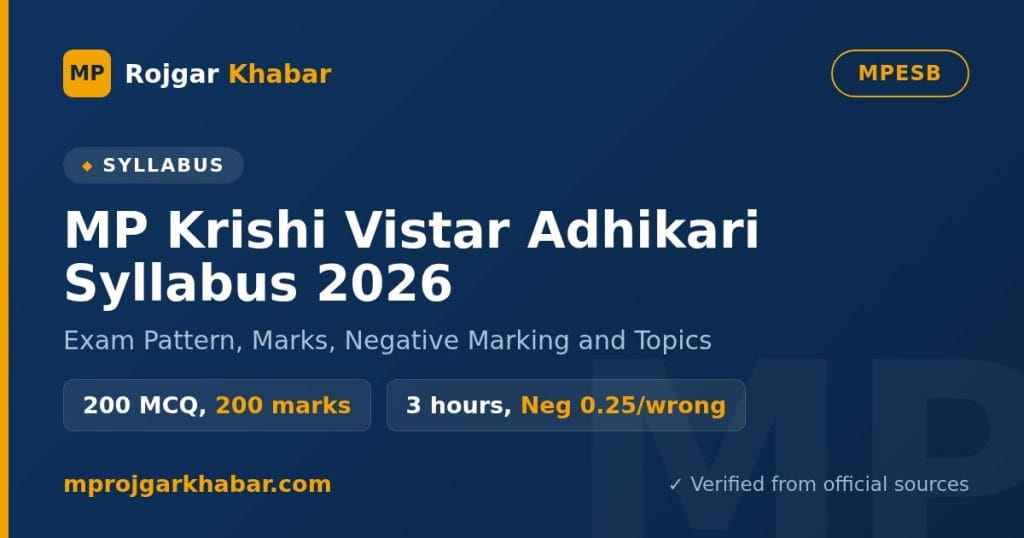
📋 At a Glance
- Exam
- Krishi Vistar Adhikari (Group 2 Sub Group 1)
- Paper
- 1 paper, 200 MCQ, 200 marks
- Marks Split
- Part A 100 + Part B Agriculture 100
- Duration
- 3 hours
- Negative Marking
- Yes, 0.25 per wrong answer
- Qualifying
- UR 50%, reserved 40%
- Exam Date
- 2 August 2026 (Sunday)
If you searched for the MP Krishi Vistar Adhikari syllabus, here is the short answer first. The MP Krishi Vistar Adhikari (Agriculture Extension Officer) recruitment exam is conducted by the MP Employees Selection Board (MPESB) under Group 2 Sub Group 1, and it is a single computer-based paper of 200 marks with 200 objective (MCQ) questions, for which you get 3 hours. The paper has two parts: Part A - General subjects worth 100 marks and Part B - the related subject (Agriculture) worth 100 marks. Unlike the MP Police Constable and Patwari exams, this paper has negative marking of 0.25 marks for every wrong answer, so blind guessing is risky here.
Two facts should shape your whole strategy. First, Part B (Agriculture) alone carries 100 marks - a full half of the paper - so your subject knowledge is what really decides selection, not the general section. Second, because of the 0.25 negative marking, you should only answer when you are reasonably sure and avoid wild guessing. This guide covers the official exam pattern, the two-part marks split, the marking and negative-marking rule, the exam schedule, the qualifying marks by category, the complete official Part B (Agriculture) syllabus copied from the MPESB rule book, a preparation plan, and quick FAQs.
MP Krishi Vistar Adhikari exam pattern
The written exam is a single online paper of 200 marks. It is split into two parts of 100 marks each - a common general section and a subject-based section. The table below sums up the pattern exactly as stated in the official MPESB Group 2 Sub Group 1 rule book.
| Feature | Detail |
|---|---|
| Number of papers | One paper (single written exam) |
| Total questions | 200 questions |
| Question type | Objective MCQ, each question has 4 options |
| Total marks | 200 marks |
| Part A (General) | 100 marks |
| Part B (Related subject - Agriculture) | 100 marks |
| Marking scheme | +1 mark for each correct answer |
| Negative marking | Yes - 0.25 mark deducted for each wrong answer |
| Duration | 3 hours |
| Mode | Computer-based test (online) |
| Medium | Hindi and English |
So this is a longer and tougher paper than the constable or patwari exams: 200 questions instead of 100, three hours instead of two, and a real penalty for wrong answers. Half the paper is pure agriculture subject knowledge, which is why a science or agriculture background helps a lot here.
Marking scheme and negative marking
The rule book states the marking clearly. Each correct answer gives you +1 mark, and for each wrong answer 0.25 mark is deducted from your total. A question you leave unattempted neither adds nor subtracts anything.
This negative marking changes your approach compared with the MP Police Constable and Patwari exams, which have no negative marking. Here, a wrong answer actually costs you a quarter mark, so guessing blindly can pull your score down. The smart approach is to answer confidently where you know the topic or can eliminate two or three options, and to skip a question only when you have no real basis to choose. Since four wrong answers cancel out one correct answer, careful accuracy beats reckless attempting.
MP Krishi Vistar Adhikari syllabus (Part A and Part B)
The 200-mark paper is divided into two parts of 100 marks each. Part A is a general section made up of seven common subjects, and Part B is based on the related subject, which for this post is Agriculture. The table below shows the official structure.
| Part | Content | Marks |
|---|---|---|
| Part A | General Knowledge, General Hindi, General English, General Maths, General Reasoning, General Science, General Computer Knowledge | 100 |
| Part B | Related subject - Agriculture (10 units, see full list below) | 100 |
| Total | 200 |
Note one important point: the rule book lists the seven Part A subjects together for 100 marks and does not publish a separate mark split for each of them. So treat the seven subjects as one combined 100-mark general block, not as seven fixed sub-totals. Part B, however, is fully detailed with a unit-wise topic list, which is given below word for word from the rule book.
Part A - General section (100 marks)
Part A mixes seven general subjects into a single 100-mark block. The rule book gives only the subject names, so the points below are a preparation guide around those names, not an official topic list.
- General Knowledge - Madhya Pradesh GK (districts, history, culture, geography, schemes), national and international current affairs, static GK, sports and important days.
- General Hindi - grammar, synonyms and antonyms, idioms and proverbs, sentence correction and comprehension.
- General English - grammar, vocabulary, synonyms and antonyms, error spotting, fill in the blanks and comprehension.
- General Maths - number system, percentage, ratio and proportion, average, profit and loss, simple and compound interest, time and work, and basic data interpretation.
- General Reasoning - series, analogy, coding-decoding, direction sense, blood relations, classification and simple non-verbal reasoning.
- General Science - basic physics, chemistry and biology, plus everyday science and health awareness.
- General Computer Knowledge - computer basics, input and output devices, MS Office, internet and email fundamentals.
Part B - Agriculture syllabus (100 marks, official)
This is the most important part of the paper and the one you should prepare most seriously, because it carries a full 100 marks. The rule book publishes a detailed unit-wise syllabus for the Agriculture subject. The following ten units are copied directly from the official MPESB rule book.
- General Agriculture - Agriculture and its importance in the national economy.
- Agronomy - Major crops of MP, agrotechniques of major field crops of MP, farming systems and sustainable agriculture, introductory agro-meteorology, agro-climatic and agro-ecological zones.
- Soil Science - Soil and its composition and its role in crop production; physical, chemical and biological properties of soil; essential plant nutrients, their function and dynamics; integrated nutrient management; problem soils and their management.
- Soil and water conservation, watershed management.
- Plant Physiology - Absorption, translocation and metabolism of nutrients; photosynthesis and respiration; growth and development; growth regulators.
- Crop Improvement - Elements of genetics and plant breeding as applied to crop improvement.
- Horticulture - Package of practices of important fruit, vegetable, spices and economically important flowering plants; nursery management and propagation methods of horticultural crops; problems (unfruitfulness, alternate bearing, fruit drops etc.) and physiological disorders and their management; post-harvest management and value addition of fruits and vegetables.
- Plant Protection - Important insect pests and diseases affecting important crops and their management; components of integrated pest and disease management; spray equipment, their selection and maintenance; rodent management; safety precautionary measures during pesticide usage.
- Agricultural Economics - Meaning and principles of economics as applied to agriculture; farm planning and resource management for optimal production; farming systems and their economic role; marketing of agricultural produce and regulated markets in MP including initiatives like e-chaupal; price of agricultural produce and its role in agricultural production.
- Agricultural Extension Education - Philosophy, objectives and principles of extension; extension organizations at the state, district and block levels, their structure, functions and responsibilities; methods of communication; role of farmers' organizations in extension services; role and importance of trainings; important rural development programmes in India.
Because this is the exact official list, build your Agriculture preparation around these ten units. Extension Education (unit 10) and Agricultural Economics (unit 9) are especially relevant to the job role of an extension officer, so do not skip them even though they come at the end of the list.
Exam schedule and important dates
The exam is scheduled to begin on 2 August 2026 (Sunday) and will be held in two shifts on the exam day. Both shifts run for 3 hours. The table below shows the shift timings and the application dates as stated in the official notification.
| Event | Detail |
|---|---|
| Online form start date | 3 July 2026 |
| Online form last date | 17 July 2026 |
| Correction window | 3 July 2026 to 22 July 2026 |
| Exam date | 2 August 2026 (Sunday), onwards |
| Shift 1 timing | 9:00 AM to 12:00 PM (3 hours) |
| Shift 2 timing | 2:30 PM to 5:30 PM (3 hours) |
| Admit card | To be released before the exam (check esb.mp.gov.in) |
Since the exam runs across two shifts, the MPESB uses a normalisation (proportionate score) method to fairly compare candidates who sit in different shifts, and the final merit is prepared on those normalised scores.
Qualifying marks by category
To be included in the list of successful candidates, you must score at least the minimum qualifying marks fixed for your category. As per the rule book, the minimum qualifying marks are:
- Unreserved (UR): 50 percent
- SC, ST, OBC and PwD (Persons with Disabilities): 40 percent (a 10 percent relaxation)
- EWS: a 10 percent relaxation in minimum qualifying marks is given, but final selection is made on merit from the EWS list (as per the MP General Administration Department circular).
Keep in mind that qualifying marks only make you eligible for the merit list. Actual selection depends on your rank against the number of vacancies, so aim well above the minimum, not just at it.
How to prepare for the MP Krishi Vistar Adhikari exam
- Make Part B (Agriculture) your top priority - it is 100 marks and decides selection. Work through all ten official units, giving extra time to Agronomy, Soil Science, Horticulture and Extension Education.
- Use standard agriculture textbooks and the ICAR or state agriculture university material for the subject units, and focus on MP-specific points (major crops of MP, agro-climatic zones of MP, regulated markets and e-chaupal).
- For Part A, give steady time to MP GK and current affairs, since general knowledge is a reliable scoring area, and keep your Hindi, English, maths and reasoning basics sharp.
- Respect the negative marking - practise accuracy, and mark an answer only when you know it or can eliminate options. Do not attempt questions blindly.
- Manage time - 200 questions in 180 minutes is a little under a minute per question, so keep a steady pace and do not get stuck.
- Take full-length computer-based mock tests that mix the general and agriculture sections to build both speed and stamina for the 3-hour paper.
Before you prepare, make sure you are eligible and understand the wider recruitment. See our full guides on the MP Krishi Vistar Adhikari Recruitment 2026 (2,784 posts), the detailed MP Krishi Vistar Adhikari eligibility, and the MP Krishi Vistar Adhikari salary to know the pay and career growth.
Frequently Asked Questions
What is the syllabus of MP Krishi Vistar Adhikari exam?
The MP Krishi Vistar Adhikari exam is a 200-mark paper split into two parts. Part A (100 marks) covers seven general subjects - General Knowledge, General Hindi, General English, General Maths, General Reasoning, General Science and General Computer Knowledge. Part B (100 marks) is the Agriculture subject, with ten official units covering General Agriculture, Agronomy, Soil Science, Soil and Water Conservation, Plant Physiology, Crop Improvement, Horticulture, Plant Protection, Agricultural Economics and Agricultural Extension Education.
What is the exam pattern of MP Krishi Vistar Adhikari?
It is a single computer-based paper with 200 objective MCQ questions (each having 4 options) for a total of 200 marks, and the duration is 3 hours. The medium is Hindi and English. The paper has two parts of 100 marks each: Part A (general subjects) and Part B (Agriculture). You get +1 mark per correct answer and 0.25 mark is deducted for each wrong answer.
Is there negative marking in the MP Krishi Vistar Adhikari exam?
Yes. There is negative marking of 0.25 mark for every wrong answer. You get +1 mark for each correct answer, 0.25 mark is deducted for a wrong answer, and an unattempted question neither gains nor loses marks. Because four wrong answers cancel one correct answer, you should avoid blind guessing and answer only when you are reasonably sure.
How many questions are asked in the MP Krishi Vistar Adhikari exam?
There are 200 questions, each worth 1 mark, for a total of 200 marks. They are objective multiple-choice questions with 4 options each, split as Part A (general, 100 marks) and Part B (Agriculture, 100 marks), and you get 3 hours to attempt them.
What are the qualifying marks for MP Krishi Vistar Adhikari exam?
As per the rule book, the minimum qualifying marks are 50 percent for unreserved (UR) candidates and 40 percent for SC, ST, OBC and PwD candidates (a 10 percent relaxation). EWS candidates get a 10 percent relaxation in qualifying marks, with selection made on merit from the EWS list. Qualifying marks only make you eligible for the merit list; final selection depends on your rank against the vacancies.
Which subject is asked in Part B of the MP Krishi Vistar Adhikari exam?
Part B is based on the related subject, which for the Krishi Vistar Adhikari (Agriculture Extension Officer) post is Agriculture. It carries 100 marks and has a detailed ten-unit official syllabus covering agronomy, soil science, horticulture, plant protection, agricultural economics and extension education, among others. There is a single Agriculture syllabus - the rule book does not offer a separate stream choice for this post.
When is the MP Krishi Vistar Adhikari exam 2026?
The exam is scheduled to begin on 2 August 2026 (Sunday) and is held in two shifts - 9:00 AM to 12:00 PM and 2:30 PM to 5:30 PM - each of 3 hours. The online application window was 3 July to 17 July 2026, with a correction window up to 22 July 2026. Always confirm the exact exam date and admit card release on the official MPESB website.
Last verified: 9 July 2026 (exam pattern, marking, qualifying marks and the full Agriculture syllabus taken directly from the official MPESB Group 2 Sub Group 1 rule book dated 2 July 2026 at esb.mp.gov.in). Exam schemes can be revised, so always confirm the pattern and syllabus in the latest official notification before you start preparing.
Disclaimer: mprojgarkhabar.com is a private, independent website - NOT an official government portal. Always verify all details on the official website before acting.